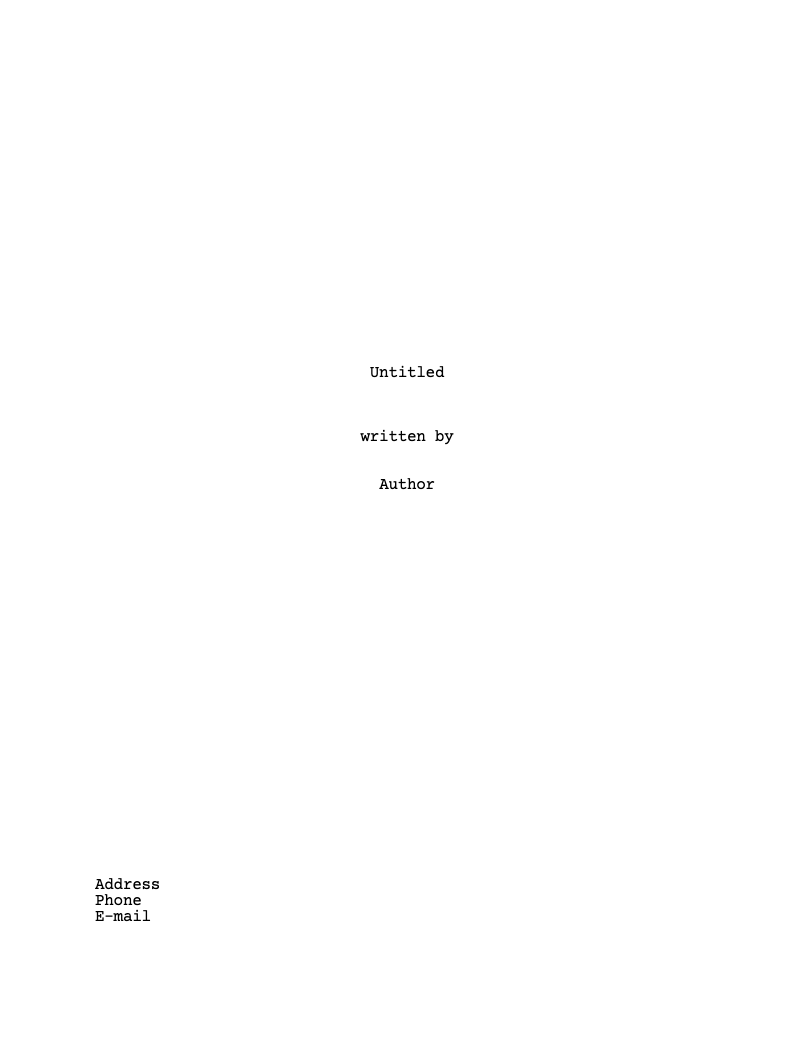
Title Page
When you create a new project, it automatically includes a Title Page document. This document is separate from your main script document and is set to the Title Page template, which has its own unique line types to help you format an industry-standard Title Page. Your project's Title and your Author name will come pre-loaded in the document, but you can edit this text and add other common title page-specific information (e.g. your contact information) to customize it before you export it with your script.
In This Article
How to Open Your Project's Title Page Document
-
Select the gray Navigate to title page button in the top righthand corner of the first page of your script document
-
- Depending on your layout, you can open the Project widget by either selecting the Project icon in the left sidebar or selecting the Project Documents tab in the right widget panel.
-
Select Title Page from your Project Documents list

How to Edit a Title Page
Core Line Types
-
Title - Name of script. This line type will format text in the center of the page by default.
- By default, the Title line of your Title Page is synced to your project's name. If you edit the text of your Title line, it will rename the project to match that edited text. If you rename your project, the Title line's text will be edited to match that renamed project. To un-sync the Title line from your project's name, you can take the following steps:
- Go to Menu > File > Rename Project
- Uncheck the box next to Sync project name on Title Page
- Click the "X" icon in the top right of the Rename Project modal to close
- By default, the Title line of your Title Page is synced to your project's name. If you edit the text of your Title line, it will rename the project to match that edited text. If you rename your project, the Title line's text will be edited to match that renamed project. To un-sync the Title line from your project's name, you can take the following steps:
- Author - Name of author(s) of the script. This line will format text in the center of the page by default.
- Text - Miscellaneous text in your title page with no special formatting or line spacing
- The "Written By" text that is pre-loaded in your Title Page will be formatted to this line type and will be centered by default.
Additional Line Types
-
Address - Physical home address of the author(s) of the script for contact purposes
-
Phone - Phone number of the author(s) of the script for contact purposes
-
Email - Email address of the author(s) of the script for contact purposes
-
Copyright - Any script-specific copyright information or WGA script registration number
-
You can insert the © copyright symbol by:
- Windows: Holding down
Altand typing0169on the numeric keypad - Mac: Using the shortcut
Option + G - iOS/Android Mobile Devices: Opening the emoji keyboard and selecting ©
- Windows: Holding down
-
For more information on how to apply for a copyright of your script or register it with the Writers Guild of America:
-
Copyright your script under the Performing Arts category here: copyright.gov/registration/performing-arts/
-
Register your script with the WGA here: https://www.wgawregistry.org/register.aspx.
-
-
-
Image - Insert multimedia, such as images, videos, or audio to customize your Title Page for personal/creative reasons
-
Note: Most industry-standard Title Pages do not have images, videos, or audio. To view examples of professionally-produced script Title Pages, check out our blog article, How to Make a Screenplay Title Page.
-
Outlining Line Types
-
Note - Indented comments that remain within the title page for reference but do not count towards the document's page count
-
Outline - Lines used to provide structural guidance and are hidden unless Show Outline is enabled
- Pressing Enter after an Outline line continues as another Outline line.
How To Close Your Project's Title Page Document
-
Select the grey Navigate to script button in the bottom center of the Title Page document
- Note: If you are in the Default layout, clicking Navigate to script will close the Title Page document and open your project's Default Document. If you are in any other layout (Flow, Simplified, Classic, etc.), clicking Navigate to script will open your project's Default Document in a new document tab and keep the Title Page document open as its own separate document tab.
- Place your cursor in the Title Page document you'd like to close
-
Select Menu > File > Close Tab
How to Export Your Title Page Document With Your Script Document
Other Title Page Options
Add Additional/Alternate Title Page Documents to Your Project (Paid-only feature)
-
Open the Project widget
- Depending on your layout, you can open the Project widget by either selecting the Project icon in the left sidebar or selecting the Project Documents tab in the right widget panel.
-
Select Add Document
-
Type a document name that is unique/different from your project's default Title Page
-
Set the template to Title Page
-
Click the blue Create button
- You can then open, edit, and organize this additional title page document via the Project widget.
- To export this alternate title page document with your script document instead of your project's default Title Page, go to Menu > File > Export, click + drag the alternate title page document into the Include section, click + drag the default Title Page document into the Do Not Include section, and click Export. For more in-depth information on your project document exporting options, see Export a Document.
Apply a Custom Title Page (Pro-only feature)
Upload a PDF file of a uniquely-designed Title Page you created outside of the WriterDuet app. This custom title page will not be visible in the project. You will only be able to see it upon exporting.
- Select Menu > Customize > PDF
- Check the box for Custom title page
- Select Choose File to upload a PDF of the custom title page
- The Custom Title Page will only be visible upon export.
Example Title Page